
Former MP Christopher Kang’ombe Calls for Clarity on Ndola Refinery Logistics

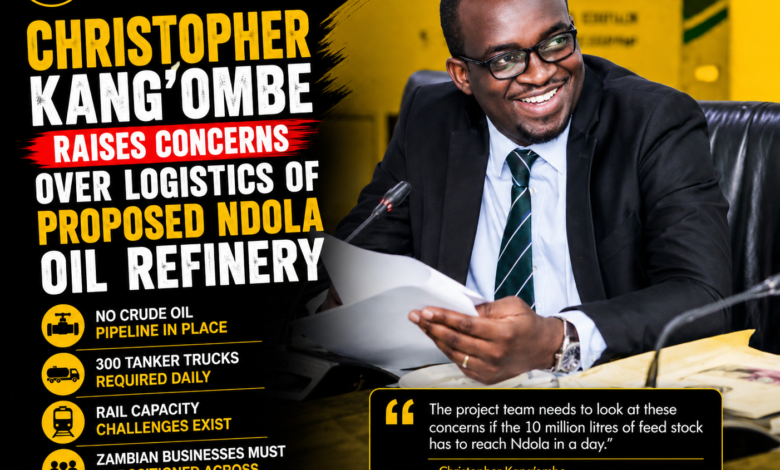
Christopher Kang’ombe Questions Logistics Behind Proposed Ndola Oil Refinery
Former Member of Parliament and development policy specialist Christopher Kang’ombe has raised questions about the logistics of supplying crude oil to the proposed ZPEC oil refinery in Ndola, arguing that the project’s success will depend not only on refining capacity but also on an efficient supply chain.
In a public commentary, Kang’ombe noted that the proposed refinery is expected to process 60,000 barrels of crude oil per day, equivalent to approximately 10 million litres every 24 hours.

While describing the refinery’s engineering design capacity as impressive, he questioned how such a large volume of crude oil would be transported from Dar es Salaam, Tanzania, to Ndola, given that Zambia currently lacks a dedicated crude oil pipeline for the project.
Pipeline Challenge
According to Kang’ombe, constructing a new pipeline stretching approximately 1,700 kilometres alongside the existing infrastructure would require investment estimated at over US$1 billion and could take as long as five years to complete.
He argued that without such infrastructure, transporting the required volumes of crude oil could become a major logistical challenge.
Road and Rail Capacity
Kang’ombe further observed that if crude oil were transported by road, and assuming each tanker carries between 35,000 and 40,000 litres, approximately 300 tanker trucks would be required every day to meet the refinery’s projected processing capacity.
He said logistics and transport experts would need to assess whether such volumes could realistically be delivered daily.
Rail transport, he added, could provide an alternative, but questions remain about whether Zambia’s current rail infrastructure could consistently handle the required daily volumes.
Call for Local Participation
Beyond logistics, Kang’ombe also urged project planners to consider the extent to which Zambian businesses will participate throughout the refinery’s value chain—from construction and procurement to long-term operations and maintenance.
He said ensuring meaningful local participation would maximize the project’s economic benefits for the country.
About the Project
The proposed refinery is expected to be developed and operated by ZPEC, a joint venture between Fujian Xiang Xin Corporation and Zambia’s Industrial Development Corporation (IDC).
As planning progresses, Kang’ombe believes addressing infrastructure and supply chain questions early will be essential to the project’s long-term success.