
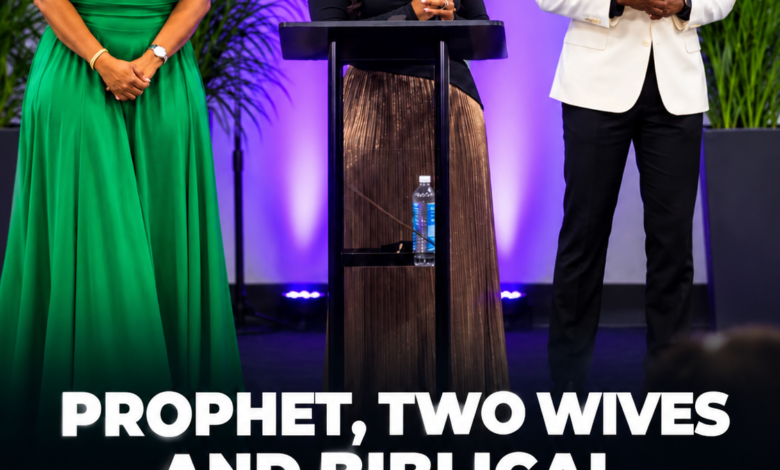
By Rev. Walter Mwambazi | A Prophetic Reflection
A controversial video reportedly showing an American pastor introducing his second wife to a congregation alongside his first wife has sparked a debate about biblical marriage, church leadership and the interpretation of Scripture.

In a reflection titled “When the Pulpit Becomes an Altar of Compromise: A Prophet, Two Wives and the Great Falling Away,” Rev. Walter Mwambazi questions the biblical justification for polygamy within the New Testament church, warning against the use of Scripture to legitimise practices he believes contradict established Christian teachings.
According to Mwambazi, the video features Prophet Israel Ford of LifeWorks Church in Ohio introducing his second wife, Minister Shakayla Ford, alongside his first wife, Pastor Lydia Ford. He further claims that the pastor defended his position by arguing that the teaching of one man having one wife is unbiblical.
Zambianwifi has not independently verified the video or the circumstances surrounding the reported introduction.
GOD’S ORIGINAL DESIGN FOR MARRIAGE
Mwambazi argues that the Christian understanding of marriage must begin with God’s original design as described in Genesis 2:24, where a man leaves his parents, is united to his wife, and the two become one flesh.
He also points to Matthew 19:4–6, where Jesus refers to the creation account when teaching about marriage.
According to the reverend, the fact that several biblical figures had multiple wives does not automatically mean that every such arrangement represents God’s intended standard for marriage.
He argues that Christians must distinguish between events recorded in Scripture and practices presented as examples for believers to follow.
“Not everything that happened in the Bible was approved by God, and not everything that carries the name of God has His endorsement,” Mwambazi emphasises in his reflection.
NEW TESTAMENT EXPECTATIONS FOR CHURCH LEADERS
The reverend places particular emphasis on 1 Timothy 3:2 and Titus 1:6, passages that describe the expected character of church overseers, including the requirement that a leader be the husband of one wife.
He argues that spiritual leadership requires more than the ability to preach, prophesy or attract a congregation. Church leaders must also demonstrate integrity and uphold the standards they teach.
Mwambazi acknowledges that the precise interpretation of the biblical expression commonly translated as “the husband of one wife” is debated among scholars. Nevertheless, he maintains that the passages establish a serious expectation of marital faithfulness and exemplary conduct for church leaders.
He also invokes James 3:1, which warns that teachers will be judged more strictly, arguing that the pulpit should not become a platform for justifying personal preferences through selective interpretation of Scripture.
BIBLICAL HISTORY DOES NOT AUTOMATICALLY ESTABLISH A STANDARD
Addressing arguments that point to Abraham, Jacob, David and Solomon, Mwambazi says the presence of polygamy in biblical history should not be confused with an endorsement of every aspect of those relationships.
He refers to the complicated family circumstances involving Abraham, Sarah and Hagar, as well as Jacob, Leah and Rachel, to illustrate the conflicts that arose within those households.
He also cites 1 Kings 11:1–4, which describes how Solomon’s many foreign wives turned his heart away from God.
For Mwambazi, these accounts demonstrate why Christians should examine biblical narratives in their wider context rather than use isolated examples to support a preferred position.
He further refers to Matthew 19:8, where Jesus discusses Moses’ allowance for divorce in the context of human hardness of heart, arguing that the regulation of a practice does not necessarily make it the ideal for Christian living.
MARRIAGE AS A REFLECTION OF CHRIST AND THE CHURCH
Another central argument in Mwambazi’s reflection comes from Ephesians 5:25–32, which compares the relationship between a husband and wife to Christ’s relationship with the Church.
He argues that Christian marriage carries spiritual significance and should reflect sacrificial love, commitment and faithfulness.
According to the reverend, believers should therefore approach discussions about marriage by considering not only historical biblical practices but also the principles and symbolism presented in the New Testament.
He maintains that marriage should not be redefined simply because particular arrangements existed among biblical figures.
A WARNING AGAINST DOCTRINAL COMPROMISE
Mwambazi’s strongest concern is what he describes as the growing tendency to attach biblical language to teachings that have not been adequately examined against Scripture.
He points to what he considers broader problems within parts of the contemporary Church, including prosperity teaching without accountability, prophecy without discernment, grace without repentance and leadership without moral boundaries.
Drawing on 2 Thessalonians 2:3, 2 Timothy 4:3–4 and 1 Timothy 4:1, he warns Christians to remain alert to teachings that may depart from what they understand as sound doctrine.
However, Mwambazi also makes an important distinction: he says he cannot pronounce judgment on the pastor’s eternal destiny or private motives, and he acknowledges that one incident alone does not establish that the final apostasy has arrived.
His argument, rather, is that public religious teachings can and should be examined against Scripture.
He insists that compassion for people in complicated marital circumstances must not be confused with an obligation to endorse every decision or interpretation.
THE CHURCH MUST RETURN TO SCRIPTURE
In his concluding remarks, Mwambazi calls on Christian leaders to uphold their understanding of biblical truth even when doing so is unpopular.
He argues that churches should provide pastoral care without humiliating people, while remaining committed to the doctrines they teach.
Citing Jude 1:3, which calls believers to contend earnestly for the faith, he urges church leaders and congregations to take their responsibility for biblical teaching seriously.
His central message is that religious authority should come with accountability and that Scripture should not be used merely to justify human desires.
“The Church must return to Scripture before Scripture becomes nothing more than a tool for justifying human desires,” is the central warning of his reflection.
Whether Christians agree with every aspect of Mwambazi’s interpretation or not, his commentary raises broader questions about biblical interpretation, pastoral accountability, marriage and the responsibility of religious leaders to explain the foundations of their teachings.
For believers, the challenge remains to engage such debates with careful study of Scripture, humility and respect, while distinguishing established facts from claims that have yet to be independently verified.