
By Guest Contributor
I believe it is time for the Bank of Zambia, the Competition and Consumer Protection Commission (CCPC), the Ministry of Finance and National Planning, and other relevant authorities to take a serious look at Zambia’s rapidly growing online lending industry.

This is no longer simply a question of whether people should repay the money they borrow. Of course they should.
The bigger question is whether some of the terms being offered to financially vulnerable Zambians amount to fair and responsible lending.
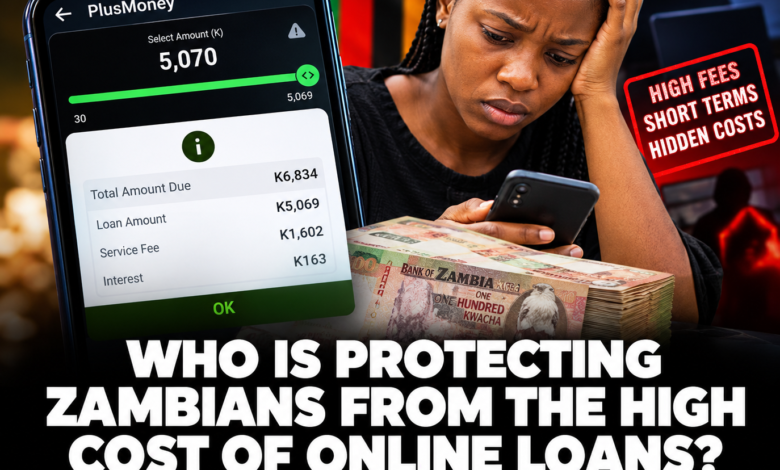
Consider this loan offer displayed on PlusMoney/Credichola:
- Loan amount: K5,069
- Duration: 8 days
- Interest: K163
- Service fee: K1,602
- Total amount due: K6,834
A person borrows K5,069 and is expected to find K6,834 just eight days later.
That means the borrower pays an additional K1,765, equivalent to approximately 34.8% of the amount borrowed in just eight days.
But this is where I believe regulators need to look much deeper.
Only K163 is described as interest.
Another K1,602—approximately 31.6% of the principal—is described as a “service fee.”
So, what exactly is this K1,602 service fee?
What service associated with an eight-day digital loan costs the customer almost one-third of the amount they are borrowing?
More importantly, from a consumer-protection perspective, should regulators focus only on the amount labelled “interest,” or should they examine the total cost of credit, regardless of what individual charges are called?
Because to the borrower, terminology changes nothing.
You receive K5,069.
You must return K6,834.
The difference coming out of your pocket is K1,765.
That is the economic reality.
THE QUESTION OF RESPONSIBLE LENDING
This is precisely the kind of issue that regulators should examine.
Zambia’s lending and consumer-protection framework contains provisions governing interest and other charges associated with loans, including protections against certain transactions that may be considered harsh or unconscionable.
The question, therefore, is whether the total cost and structure of some short-term digital loans are consistent with the principles of fair and responsible lending.
This is not an argument that borrowers should escape their obligations.
It is an argument that lenders should also fulfil their obligations to consumers.
WHAT ABOUT DEBT COLLECTION PRACTICES?
Another issue requiring investigation is the manner in which some digital lenders allegedly pursue customers for repayment.
Borrowers have an obligation to honour their agreements.
But lenders also have obligations.
If a loan is contractually due tomorrow, why should aggressive and persistent collection calls begin today?
Why should a customer allegedly be spoken to using unpalatable language, intimidated or made to feel like a criminal when the agreed repayment date has not even passed?
Taking out a loan does not mean surrendering your dignity.
Financial difficulty does not make someone a criminal.
And owing a company money does not give that company or its agents unlimited authority over how they communicate with customers.
These concerns become even more important when dealing with financially vulnerable consumers who may already be struggling to meet basic expenses.
WHAT HAS BEEN DONE TO PROTECT CONSUMERS?
The Bank of Zambia has previously warned the public about unlicensed online credit providers and has acknowledged receiving complaints concerning predatory lending practices.
That raises an important question:
What more needs to be done?
I would specifically like the relevant authorities to establish:
- Is Credichola/PlusMoney properly licensed or authorised to provide these loans in Zambia, and under what regulatory framework?
- Is an eight-day loan costing approximately 34.8% of the principal consistent with Zambia’s consumer-protection and lending requirements?
- How is a K1,602 “service fee” on a K5,069 loan calculated and justified?
- When assessing the cost of credit, are service fees and similar charges examined together with stated interest?
- Why are consumers being offered extremely short repayment periods instead of reasonable 30-day or instalment options?
- What rules govern collection calls and messages before and after a loan’s contractual due date?
- Are borrowers clearly informed of the true total cost of borrowing before accepting these loans?
- What safeguards exist to prevent vulnerable borrowers from becoming trapped in a cycle of borrowing from one platform to repay another?
These are legitimate consumer-protection questions that deserve clear answers.
THIS IS NOT AN ATTACK ON DIGITAL LENDING
This is not a campaign against digital lending.
Digital credit has a legitimate place in the economy.
There are times when someone needs K500, K2,000 or K5,000 urgently and cannot wait weeks for a traditional financial institution to process a loan application.
Digital lending can provide that convenience.
But convenience cannot become a licence for exploitation.
If companies are going to lend money to Zambians, then consumers should be able to expect reasonable charges, transparent pricing, realistic repayment periods and professional debt-collection practices.
Give customers a proper 30-day repayment option and, for larger amounts, reasonable instalment plans.
And if a company wants to charge a service fee, consumers and regulators should understand exactly what service they are paying for and why that service costs as much as it does.
TIME FOR A PROPER INVESTIGATION
I am calling on the Bank of Zambia, CCPC and other relevant authorities to investigate—not through assumptions and not through social-media arguments, but by examining the actual evidence.
Investigate the loan agreements.
Investigate the licences.
Investigate the interest charges.
Investigate the service fees.
Investigate the repayment periods.
Investigate the collection calls and messages.
Investigate how customers’ personal information and contacts are being used during debt collection.
And then tell the Zambian public whether these practices comply with the country’s laws and consumer-protection standards.
If they are lawful, explain to the public why a Zambian can borrow K5,069 and be required to find K6,834 only eight days later.
If they are not lawful, then enforce the law.
ZAMBIANS DESERVE FAIRNESS AND DIGNITY
I encourage anyone who has experienced similar treatment from an online lender to preserve their documentation.
Keep your loan agreements, screenshots, repayment schedules, call logs, SMS messages, WhatsApp messages and proof of payments.
Submit documented complaints to the relevant authorities where appropriate.
One complaint can be dismissed as an isolated experience.
Hundreds of documented cases become evidence of a problem that cannot be ignored.
Zambians need access to emergency credit.
But they also deserve fairness, transparency, reasonable lending terms and dignity.
A borrower is a customer—not a criminal.
#ProtectZambianConsumers #BankOfZambia #CCPC #DigitalLoans #ResponsibleLending #ConsumerProtection #Zambia