State House Rejects Arbitrary Arrest Claims, Defends Ongoing Security Investigations

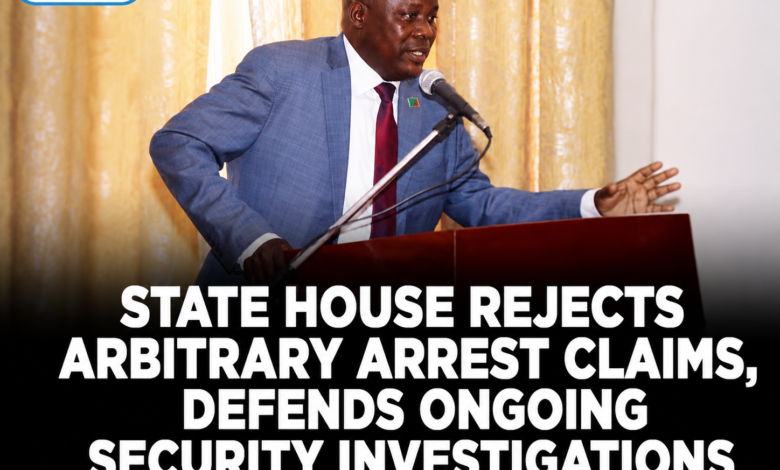
STATE House Chief Communications Specialist Clayson Hamasaka has dismissed as false and alarming claims that law enforcement agencies are arbitrarily arresting citizens, insisting that authorities are conducting lawful investigations into suspected criminal activities.
Mr. Hamasaka said there was what he described as a sustained campaign by some citizens and sections of the opposition-aligned media to portray legitimate investigations by Zambia’s security and law enforcement agencies as politically motivated arbitrary arrests.

He argued that the narrative deliberately blurs the distinction between an arbitrary arrest and a lawful investigation.
“Zambia is a constitutional democracy governed by the rule of law. Political affiliation, public prominence or claims of persecution cannot confer immunity from lawful investigation where competent authorities have reasonable grounds to investigate suspected criminal conduct or threats to national security,” Mr. Hamasaka said.
According to Hamasaka, several matters currently attracting public attention involve serious allegations that require investigation, including reports concerning the alleged discovery of high-grade military weapons at private residences and claims that certain individuals received specialised or mercenary-style training abroad.
He also cited alleged public statements calling for violence against fellow Zambians, threats against the President, and attempts to declare a presidential election outcome before the constitutionally mandated authority had completed the electoral process.
“These are not trivial matters,” Hamasaka said, arguing that such allegations touch on national security, constitutional order and public safety.
He said it was the responsibility of the State and security agencies to investigate credible information relating to suspected criminal conduct, secure possible evidence and establish whether offences had been committed.
Mr. Hamasaka stressed that investigations should be allowed to proceed professionally, impartially and within the confines of the law.
Where sufficient evidence is established, he said, matters should ultimately be determined by the courts, while those against whom no evidence is found should not face prosecution.