Oliver Shalala on former Botswana President Ian Khama on Branding HH a Dictator

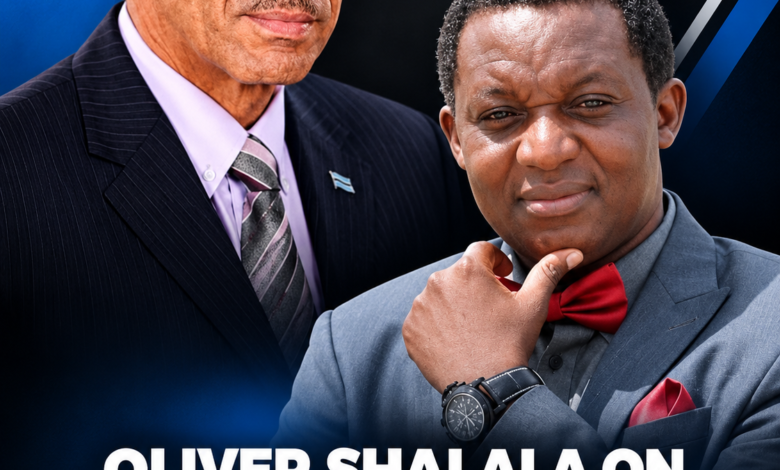
One of President Hakainde Hichilema’s many unofficial defenders has apparently appointed himself Minister of Insults and International Relations!
His latest reported target is former Botswana President Ian Khama, who has reportedly criticised Zambia’s political direction and described Hichilema as “Africa’s newest dictator.”

According to a statement circulating online, Oliver Shalala responded to Khama with a personal attack, writing:
“This ka gay man is so bitter because the party of his best friend lost power in Zambia and he has lost the chance to run businesses in Zambia.”
If accurately reported, the response raises an important question: Why do some political defenders resort to personal insults when confronted with criticism of the government they support?
On October 29, 2026, Khama reportedly questioned the attendance of Botswana’s Foreign Affairs Minister at President Hichilema’s inauguration, while also making a serious assessment of Zambia’s democratic direction.
Such criticism, whether one agrees with it or not, deserves a substantive response. Concerns about democracy, governance and the rule of law should be addressed through facts, evidence and reasoned argument—not speculation about someone’s private life.
Yet, according to the reported exchange, the discussion quickly shifted from the state of democracy to an attack on Khama’s sexuality and an accusation that he was bitter over political developments in Zambia.
Imagine the irony: a former Head of State raises questions about democratic governance, and the response from a government defender allegedly centres on personal insults rather than the substance of those concerns.
Ba spokesperson, the question was about democracy, not bedroom arrangements!
Of course, being a former president does not make Ian Khama immune to criticism. His statements can be challenged, his arguments examined, and his conclusions disputed. Nobody should be above scrutiny simply because they once occupied the highest office in their country.
But there is a difference between challenging an argument and attacking the person making it.
If Khama is wrong about Zambia’s democratic record, the appropriate response would be to explain why. Point to the evidence. Discuss the state of the institutions. Defend the government’s record on civil liberties, accountability and the rule of law.
That would be a meaningful political debate.
Personal insults, however, do little to answer difficult questions. They can instead distract from the original issue and reinforce the impression that some defenders of political power are more interested in silencing critics than engaging with their arguments.
The bigger concern is the message this kind of political discourse sends. Democracy is not strengthened by demanding unquestioning loyalty to those in power. Nor is it protected by treating every critic as an enemy, a bitter political actor or someone with a hidden personal agenda.
A healthy democracy must be able to withstand criticism from citizens, opposition figures, journalists and former leaders from neighbouring countries. Criticism may sometimes be unfair, exaggerated or politically motivated, but the answer should still be a reasoned response.
Zambia’s democratic standing should not depend on whether foreign leaders praise or criticise the President. It should be measured by the strength of its institutions, the independence of its judiciary, the protection of citizens’ rights and the ability of people to express dissent without intimidation.
Ultimately, no amount of praise-singing can substitute for accountability, and no insult can establish democratic credibility.
If the criticism is unfounded, dismantle it with facts. If it exposes genuine weaknesses, address them.
You cannot insult your way into democratic credibility. And no amount of praise-singing can substitute for the rule of law.