Who Owns Macro Ocean? Transparency Debate Grows Over Lusaka–Ndola Road Project

Who Really Owns Macro Ocean? Questions Continue Over Lusaka–Ndola Road Concessionaire
Questions surrounding the ownership of Macro Ocean Investment Consortium (MOIC), the concessionaire for Zambia’s Lusaka–Ndola Dual Carriageway, continue to generate public debate as calls grow for greater transparency regarding one of the country’s largest infrastructure projects.
The discussion has gained renewed attention following commentary published by The Zambian Times Post, which distinguishes between information that is publicly available and details that remain undisclosed.

What Is Publicly Known?
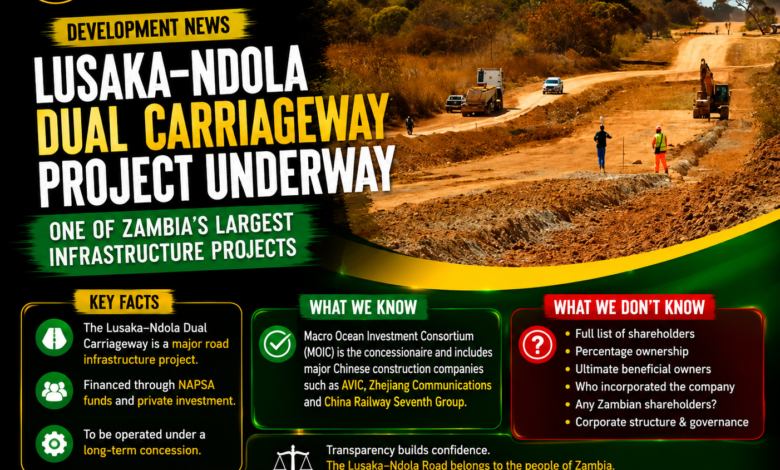
According to publicly available project information, Macro Ocean Investment Consortium is the concessionaire responsible for developing and operating the Lusaka–Ndola Dual Carriageway under a long-term concession agreement.
The consortium has previously been reported to include major Chinese engineering and construction firms, including:
- AVIC International Project Engineering Company
- Zhejiang Communications Construction Group Co. Ltd.
- China Railway Seventh Group Co. Ltd.
The project is being financed through a combination of National Pension Scheme Authority (NAPSA) funds and private sector investment.
Questions That Remain
The article argues that while the project’s existence and participating companies are publicly known, several aspects of the consortium’s ownership structure have not been fully disclosed.
Among the questions raised are:
- Who are the shareholders of Macro Ocean Investment Consortium?
- What percentage does each shareholder own?
- Who are the ultimate beneficial owners?
- Who incorporated the project company?
- Are there any Zambian shareholders or local equity partners?
- What is the consortium’s governance structure?
The commentary notes that these questions relate to transparency rather than allegations of wrongdoing.
Call for Greater Transparency
The article argues that because public pension funds are involved in financing the project, citizens have a legitimate interest in understanding who owns and controls the concessionaire.
It suggests that publishing information such as company registration records, shareholder details, directors, beneficial ownership, and the procurement basis for selecting the consortium would help strengthen public confidence in the project.
According to the publication, greater transparency would help reduce speculation and reinforce public accountability over a nationally significant infrastructure investment.
Public Accountability
The Lusaka–Ndola Dual Carriageway remains one of Zambia’s most significant road infrastructure projects. As discussions continue around its financing and implementation, transparency and disclosure are likely to remain central issues in public debate.