
Opposition Commentary Questions Musokotwane’s Mining Policy Record

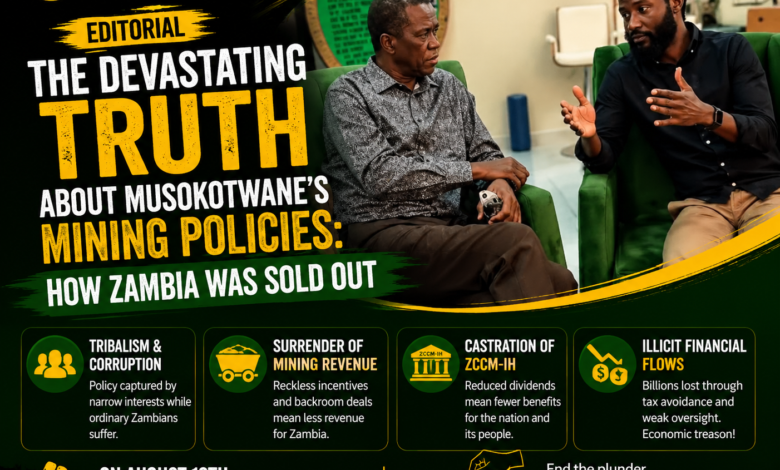
Opinion: Opposition Criticises Musokotwane’s Mining Policies Ahead of Elections
An opposition commentary circulating ahead of Zambia’s August 2026 General Elections has sharply criticised Finance Minister Situmbeko Musokotwane, alleging that government mining policies have weakened Zambia’s ability to benefit fully from its mineral wealth.
The article references views attributed to historian and political analyst Dr. Sishuwa Sishuwa, arguing that current mining policies have resulted in reduced government revenues, increased foreign corporate influence, and weakened returns for the state-owned ZCCM Investments Holdings (ZCCM-IH).

Key Claims Raised
According to the commentary, critics argue that:
- Tax incentives and mining policy reforms have reduced potential government revenue.
- ZCCM-IH has not generated the level of returns expected by some stakeholders.
- Zambia continues to lose significant resources through illicit financial flows and corporate tax avoidance.
- The country’s mining sector should generate greater benefits for citizens through increased public investment.
The commentary describes these issues as evidence of broader economic policy failures and calls on voters to consider them during the upcoming elections.
Government Position
The article reflects the views of the author and opposition critics.
The Zambian government has consistently defended its economic and mining reforms, arguing that policy changes were designed to attract investment, revive production in the mining sector, create jobs, and increase long-term economic growth.
Government officials have also maintained that reforms are intended to make Zambia a globally competitive mining destination while expanding copper production and increasing future revenue.
Mining Remains a Central Election Issue
With Zambia’s economy heavily dependent on copper exports, mining policy has become one of the key issues in the 2026 election campaign.
Political parties continue to offer differing approaches on taxation, investment, local participation, and how revenues from the country’s natural resources should be managed.
As campaigns continue, voters are expected to hear competing arguments over which policies will best balance foreign investment with maximising national benefits.